

Copyright © 2026 HLK Industries All rights reserved.
Why India Is the Top Sustainable Fashion Sourcing Hub for International Brands
By : Admin
FEB 19,2026
In 2026, fashion brands are thinking beyond price tags and production speed.
They’re asking deeper questions:
- Where are our fabrics coming from?
- Are workers treated fairly?
- Can we start with low volumes and scale responsibly?
- Is our sourcing partner aligned with our long-term sustainability goals?
India is increasingly becoming the answer to those questions.
For brands looking for sustainable apparel sourcing from India and low MOQ fashion sourcing in India, the country offers something rare: heritage craftsmanship, modern infrastructure, and ethical transformation — all in one ecosystem.
As a merchant exporter and supply chain partner, HLK Industries has seen this shift first-hand.
Table of Contents
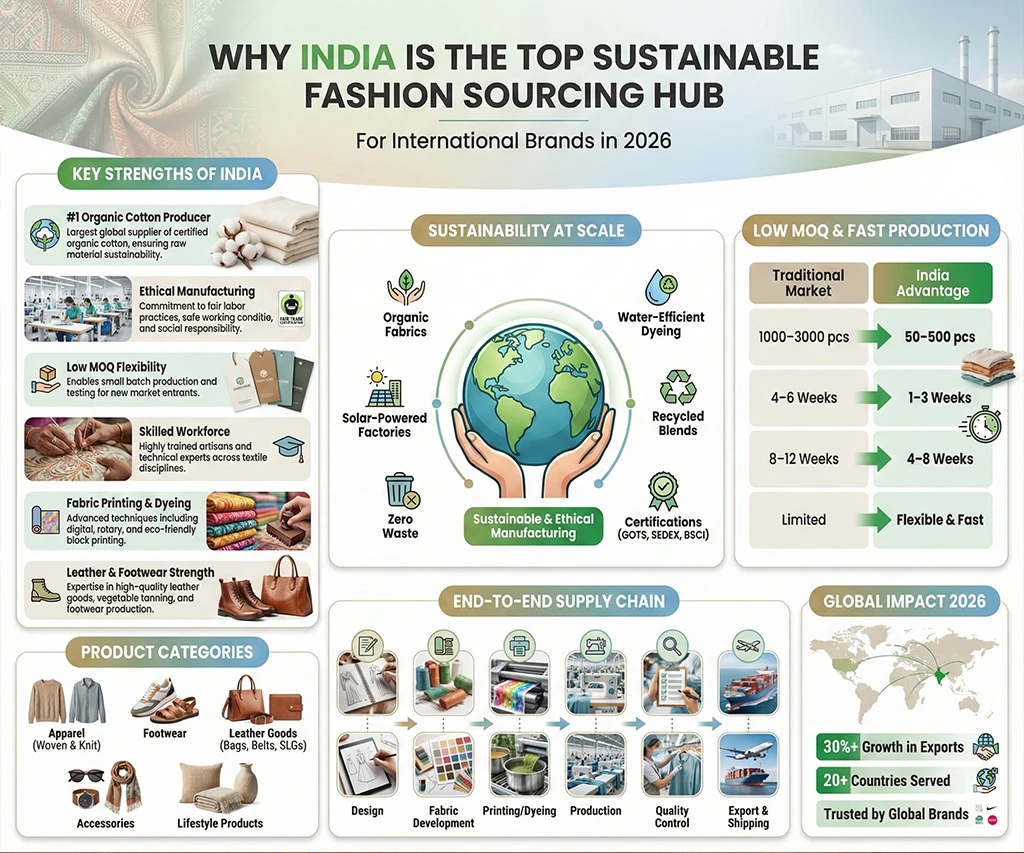
- Sustainability Is Rooted in the System, Not Added Later
- Low MOQ (Minimum Order Quantity) Sourcing
- End-to-End Fashion Sourcing Under One System
- Ethical Compliance Is Now Standard Practice
- Leather & Footwear Strength
- Speed + Sustainability = 2026 Advantage
- Why India Is the Strategic Choice for 2026
- Final Thoughts
- Frequently Asked Questions
Sustainability Is Rooted in the System, Not Added Later
Sustainability in India is not just a marketing layer. It’s embedded in:
- Organic cotton farming
- Natural dye traditions
- Water-efficient fabric dyeing
- Recycled textile innovation
- Solar-powered manufacturing units
Sustainable Sourcing Snapshot
| Area | What India Offers | Why It Matters for Brands |
|---|---|---|
| Organic Cotton | Large-scale availability | Lower carbon footprint |
| Natural Dyes | Traditional + scalable processes | Reduced chemical usage |
| Recycled Blends | Cotton & polyester recycling | Circular product development |
| Ethical Audits | SEDEX, BSCI, GOTS factories | Compliance confidence |
For brands committed to ethical fashion sourcing India, these are not small advantages — they’re strategic benefits.
Low MOQ (Minimum Order Quantity) Sourcing:
Low MOQ is a game-changer for emerging brands. One of the biggest shifts in 2026 is the rise of:
- DTC fashion startups
- Boutique sustainable labels
- Capsule collection drops
- Influencer-led brands
Large-volume-only factories don’t support this model well. India does.
Low MOQ Advantage
| Traditional High MOQ Markets | India’s Flexible Model |
|---|---|
| 1,000–3,000 pcs per style | Small-batch production possible |
| Limited design testing | Sampling-friendly ecosystem |
| Higher upfront risk | Scalable growth approach |
This makes low MOQ fashion sourcing India especially attractive for brands that want to grow responsibly without overproduction.
Through structured vendor coordination, HLK Industries helps brands start small and scale smoothly.
End-to-End Fashion Sourcing Under One System
India now supports complete product categories within one unified sourcing ecosystem:
- Apparel (woven & knit)
- Embroidered garments
- Leather goods (bags, belts, SLGs)
- Footwear sourcing
- Accessories & lifestyle products
- Fabric printing and fabric dyeing
Instead of managing separate countries for different product lines, brands can streamline operations under one coordinated sourcing structure.
Integrated Supply Chain Flow
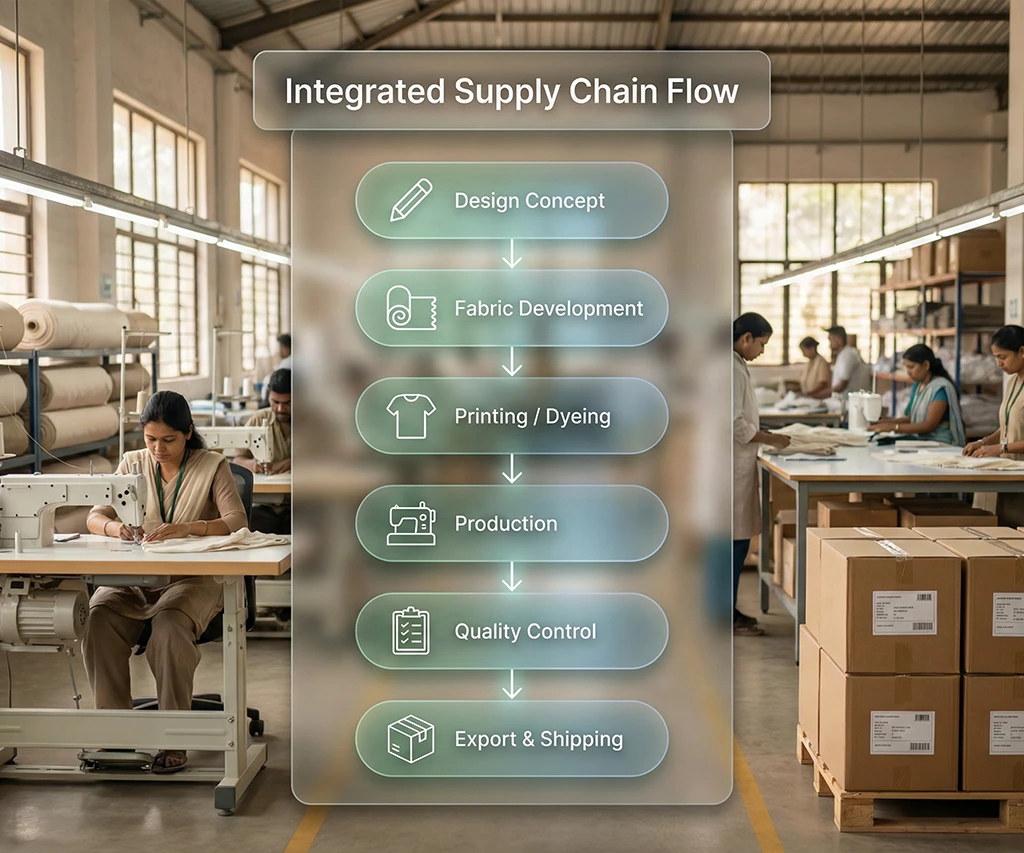
The process begins with the design concept, followed by fabric development, printing or dyeing, sampling, production, quality control, and finally export and shipping.An experienced buying house ensures each stage connects seamlessly. That coordination reduces delays, miscommunication, and compliance risk.
Ethical Compliance Is Now Standard Practice
International retailers in 2026 require:
- Transparent supply chains
- Fair wage policies
- Safe working conditions
- ESG reporting
- Traceability documentation
India’s organized manufacturing sector has significantly upgraded to meet these standards.
Compliance Comparison
| Requirement | Status in India 2026 |
|---|---|
| Social Compliance | Widely audited |
| Worker Safety | Stronger regulation enforcement |
| Environmental Controls | Increasing ZDHC & water treatment adoption |
| Transparency | Structured vendor reporting systems |
For brands entering new markets, this reduces reputational risk and builds consumer trust.
Leather & Footwear Strength
India remains one of the strongest global producers of:
- Leather bags
- Belts
- Small leather goods
- Footwear manufacturing
With growing interest in vegetable tanning and responsible leather processing, brands can now combine sustainability with craftsmanship.
This multi-category strength allows HLK Industries to support apparel, footwear, and accessories under one coordinated sourcing strategy.
Speed + Sustainability = 2026 Advantage
The old belief: sustainable sourcing is slower.
The new reality: integrated supply chains move faster.
India’s textile clusters provide:
- Faster sampling cycles
- Raw material availability
- Skilled development teams
- Improving port infrastructure
What Fast Development Looks Like
| Stage | Average Efficiency in Integrated Model |
|---|---|
| Sample Development | Faster iterations |
| Fabric Sourcing | Strong domestic availability |
| Production Scaling | Flexible capacity |
| Export Processing | Streamlined documentation |
With proper coordination, brands can reduce delays while maintaining ethical standards.
Why India Is the Strategic Choice for 2026
Here’s the bigger picture:
- ✔ Sustainability at scale
- ✔ Low MOQ flexibility
- ✔ Skilled craftsmanship
- ✔ Full product category coverage
- ✔ Ethical compliance upgrades
- ✔ Competitive cost structures
- ✔ Growing circular fashion practices
India is no longer a secondary sourcing option. It’s becoming a preferred sustainable fashion sourcing hub.
As a long-term supply chain partner for international fashion brands, HLK Industries works closely with global labels seeking transparency, flexibility, and structured export support from India.
Final Thoughts
Sourcing Decisions in 2026 Are About More Than Cost
They’re about:
- Brand values
- Consumer expectations
- Long-term growth
- Supply chain resilience
India offers a rare balance of sustainability, scalability, flexibility, and craftsmanship in one ecosystem. With the right partner guiding factory selection, compliance management, product development, and export coordination, brands can build responsibly and confidently.
The future of sustainable fashion sourcing isn’t just about producing better products. It’s about building better partnerships.
Frequently Asked Questions: Sustainable Fashion Sourcing in India
India has successfully integrated its ancient textile heritage with modern green technology. The country is now a global hub for GOTS-certified organic cotton, circular textile recycling, and solar-powered manufacturing. Unlike many regions where sustainability is an afterthought, India’s "farm-to-fashion" ecosystem allows for complete traceability.
Yes. While many traditional hubs require thousands of units per style, the Indian manufacturing landscape has evolved to support DTC startups and boutique labels. At HLK Industries, we facilitate small-batch production (often starting from 50–100 pieces for specific categories), allowing brands to test markets without the risk of overstock.
We only partner with factories that adhere to international social and environmental standards, including SEDEX, BSCI, and SA8000. Our team conducts on-site inspections to verify fair wages, safe working conditions, and zero-discharge hazardous chemical (ZDHC) practices, providing brands with full ESG reporting.
By utilizing integrated supply chains where fabric sourcing, dyeing, and stitching happen in close clusters, we’ve significantly reduced lead times.
Absolutely, India is a pioneer in vegetable-tanned leather and bio-based leather alternatives. In 2026, our footwear sourcing includes recycled rubber soles and organic canvas uppers, ensuring that your accessories are as eco-friendly as your apparel.
That is where HLK Industries acts as your "boots on the ground." We implement a multi-stage Quality Assurance (QA) process:
- Initial Inspection: Checking raw materials/fabrics.
- In-Line Inspection: Monitoring the stitching and assembly process.
- Final Random Inspection (FRI): Ensuring the finished goods meet your exact specifications before they are packed for export.
Stop Searching, Start Sourcing
Don't let high MOQs and opaque supply chains hold your brand back. Join the sustainable revolution with a partner who understands the 2026 market.
Secure My Sustainable Supply Chain →
Read Also: Benefits of Experience and Structure in a Global Fashion Sourcing Company